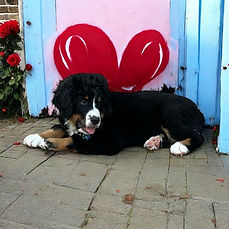
Bernedoodles
Leading the way in my opinion, Bernedoodles in America, Kennel Swiss Ridge had this to say on the breeds and the hybrid.
The Bernedoodle is a cross between a Bernese Mountain Dog and a Standard Poodle.
This hybrid blends the clever goofiness of the Poodle, with the placid loyalty of the Bernese. What’s more, the Bernedoodle is low to non-shedding, making it a safer bet for most people with allergies.
I believe the Bernedoodle is the perfect companion dog. Although many are stunning, they are not bred for the show ring. They are meant to be at your side no matter whether you are hiking, snowshoeing, or lying on the couch watching a movie. Their only job is to be your best friend.
No two Bernedoodles are identical. The genes from the parent breeds meld in unique ways, and it’s endlessly fascinating to see what each litter produces. That said, prospective owners must understand that there can be a lot of variation in a hybrid litter, and must therefore choose a breeder who can help match them with the best dog for their circumstances.
Well bred purebreds or multigenerational Bernedoodle may be the preferred choice for people who want predictability. When I was writing descriptions of my dogs, I was struck by the consistency of the traits among the purebreds. With some minor variations, one well-bred Berner is very similar to the next: sweet, loving, loyal and gentle. One well-bred Poodle is also very similar to the next: playful, intelligent, and goofy.
Notice that I emphasize “well-bred.” Like so many purebreds, Bernese and Poodles have been highly inbred over the past century. This has led not only to health problems, but also to temperament issues. Poorly bred Berners may be extremely stubborn and skittish. Poorly bred Poodles may be hyper and neurotic. It is incredibly difficult to find healthy Bernese and Poodles with calm and confident temperaments that also happen to be gorgeous.
The Bernese Mountain Dog (commonly called the “Berner”) is one of four Swiss mountain dogs developed as working farm dogs in the Swiss Alps. They were bred to be versatile helpers—guarding property, driving cattle, and pulling carts loaded with farm goods. Their name comes from the Swiss canton of Bern, where they were most commonly found. Berners are part of the Sennenhund family (along with the Appenzeller, Entlebucher, and Greater Swiss Mountain Dog) and were distinguished by their long, thick, tri-colored coats, making them especially suited to the cold alpine climate. They were officially recognized by the American Kennel Club (AKC) in 1937 and have since become beloved worldwide for their gentle nature and striking appearance.
Bernese are typically known for their easygoing nature and loyalty. They are known for being gentle giants with a kind, patient, and affectionate nature. They are completely dedicated to their families, with a special fondness for children. In fact, they are so loyal that it can be difficult to re-home an adult Berner and break its original bond. Berners are known for leaning on people to soak up all possible attention.
Berners are exceptionally beautiful dogs with their tri-coloured coats. Bred in the Swiss Alps as farm dogs that pulled carts or drove cattle to market, the Bernese do well in cold weather, and have a double coat that sheds heavily. They’re an intelligent and strong dog, having a moderate need for exercise. They do well in agility, tracking, herding, and therapy work.
A significant number of Bernese are afflicted with hip and elbow dysplasia, or succumb to inherited cancer, heart disease, degenerative myelopathy, or epilepsy in middle age. While cancer is the leading cause of death for dogs in general, Bernese have a much higher rate of fatal cancer than other breeds. Overall, the Berner is one of the shorter-lived dog breeds, with a life expectancy of just seven years. This is very sad as the Berner is known for being slow to mature, and can be challenging to train.
Without proper socialization, these naturally cautious and reserved dogs can become skittish and suspicious and may develop separation anxiety. They can also be decidedly stubborn. Yet, the Bernese also has a deep need to please their humans and are surprisingly sensitive. As a result, training a Berner requires a great deal of patience and a gentle hand.

The Poodle is one of the oldest and most versatile breeds in the world. Although often associated with France, where it became a national symbol, the breed actually originated in Germany, where it was developed as a water retriever. The name “Poodle” comes from the German word pudel or pudelin, meaning “to splash in water.” Early Poodles were prized for their intelligence, athleticism, and exceptional retrieving ability, particularly in marshes and lakes. Over time, the breed was refined in France into the elegant, stylish dog that became synonymous with French culture, but its true roots are as a hardworking, hardy hunting dog.
Poodles rank high on the canine intelligence scale and excel in obedience. Most people are aware that this lovely breed has a low- to non-shedding coat, making them a great choice for people with allergies. What people don’t realize is how lively and fun-loving Poodles can be. They are the clowns of the dog world, and it’s no coincidence they were used in circus acts for centuries.
Poodles are lively and playful, and have an assertive prance to their walk. They thrive in a busy household where there is plenty of attention to go around. Vigorous exercise and ongoing training are the keys to managing the Poodle’s exuberance. If bored, Poodles may find their way into mischief. They are also quick to sound an alert and have earned a reputation for barking.
Poodles can be nervous and sensitive to stress, and are typically affected by eye, skin, and digestive diseases, as well as immune system diseases. The most common problems are bloat/torsion, thyroid issues, sebaceous adenitis, juvenile renal disease, hip dysplasia, and cancer.
Poodles come in three sizes and a wide variety of colors. They have a single layer of dense, curly fur that sheds minimally but will mat without proper care.

If a breeder does their due diligence in selecting the right parents, crossing purebred dogs of different breeds results in puppies that are healthier than either of their parents. This is because the two breeds are generally prone to different genetic problems. Hybrids such as the Bernedoodle are only likely to inherit a health problem that is common to both the Poodle and the Bernese – two breeds that share few common diseases. Bernedoodles therefore have what is referred to as “hybrid vigor”, and can be expected to live healthier, longer lives than their purebred parents.
A hybrid dog combines the traits and characteristics of its purebred parents. With careful, conscientious breeding, the resulting pups may end up with the best attributes of each. In the case of the Bernedoodle, the blend of the Bernese and the Poodle produces a smart, friendly, playful dog. They tend to have the sweetness and loyalty of the Bernese, and the goofy liveliness and intelligence of the Poodle. Like the Bernese, they are gentle around children and the elderly.
Most Bernedoodles have a moderate activity level. They love to play, run, and hike with you. When it’s time to relax, Bernedoodles are usually happy to join you on the couch for a snuggle. Most of them have little need for personal space.
Owners most commonly describe their Bernedoodles as happy, goofy, smart, charming, curious, friendly, social, enthusiastic, cuddly and loving with a touch of sass and stubbornness.
Bernedoodles aren’t always perfect, however. Despite my efforts to breed only the best purebreds, some offspring may inherit stubbornness or sensitivity from the Bernese. Their training requires patience, a light touch, and positive reinforcement.
Bernedoodles may also inherit the Berner’s cautiousness with strangers and end up being somewhat skittish. Further, from the poodle they can inherit an extremely high level of energy.
In general, the Bernedoodle is an intelligent, social, fun crossbreed with character and charisma. On the whole, Bernedoodles tend to be quite similar to Goldendoodles in nature, with the most notable difference being that the Bernedoodle can be headstrong. I find the Goldendoodle is better for first time dog owners. Every dog has a different personality, but the two breeds have much in common, and those traits make them excellent family pets.